ClearTalk
ClearTalk is an interactive app for building speaking confidence. Through AI-driven dialogues, users can practice free talk or realistic scenarios to strengthen their fluency and prepare for real-life interactions.
Role:
Ux Research, UX/UI Design
Date:
September 2025
🤝
Introduction
Speaking is the most essential yet challenging part of language learning. While most apps focus on grammar and translation, many learners struggle with Speaking inhibition- knowing the theory but freezing in real conversations. Professional practice is often expensive and intimidating, creating a barrier to fluency. This project explores how an AI partner can provide unlimited, judgment-free speaking practice, helping users bridge the gap between passive learning and confident communication.
🧩
Problem
Despite the abundance of language learning apps and resources available, These days, learners are left behind. Most solutions focus on passive exercises like translation and multiple-choice questions, which don't prepare people for real conversations. This creates a significant gap between theoretical knowledge and practical speaking ability.
Learners face expensive tutoring options, intimidating language exchanges, lack of accessible conversation practice, and high levels of speaking anxiety. The result is millions of frustrated learners stuck at an intermediate level, unable to speak confidently despite months or years of study.
The core issue: There's a missing middle ground between beginner apps and expensive tutoring, an accessible solution that can bridge app-based learning and real conversation fluency.
🧠
Challenges
1. Creating a Safe and Supportive Learning Environment
The Challenge: Overcoming "speaking anxiety" where the fear of judgment blocks progress.
UX Goal: Design an AI tutor that feels empathetic and human-like, balancing supportive encouragement with clear, non-intimidating feedback to build user confidence.
2. Personalization and Relevant Content
The Challenge: Generic content leads to low motivation, but too many choices can overwhelm the user.
UX Goal: Create an adaptive learning flow that remembers user preferences and progress, delivering highly relevant scenarios without increasing cognitive load.

3. Balancing Voice Interaction with Visual Feedback
The Challenge: Unlike visual-heavy apps, speaking requires deep focus. A cluttered UI can distract users and break their natural conversational flow.
UX Goal: Develop a "low-friction" interface that prioritizes voice, providing subtle yet clear visual cues for pronunciation and errors without disrupting the user's focus.
🔍
Research
Market Research
I analyzed five top language practice platforms, to evaluate their support for learners from beginner speaking to confident conversation, focusing on AI use in voice, feedback, and personalization. The analysis revealed major gaps in addressing speaking anxiety and meaningful practice.

Duolingo & Babbel: Focus on grammar drills and reading, with limited, repetitive speaking tasks.

Gemini Live: Offers natural voice interaction but lacks pedagogical structure and progress tracking.
Italki: Provides empathetic human tutoring, but remains expensive, intimidating for beginners.
The Opportunity: A gap exists for a voice-first, AI-powered experience that provides gentle, adaptive feedback in a safe environment.
Secondary Research Insight
To validate the opportunity space, I analyzed peer reviewed studies, user reviews, and market data covering many language learners globally.
The research revealed three critical insights:
The "Panic" Barrier
Finding: 49% of learners experience panic when speaking without preparation, causing them to stay silent to avoid mistakes.
UX Insight: Prioritize low-pressure environment with "safety nets" like hints and translations to reduce anxiety.
2. The Theory-to-Practice Gap
Finding: Popular apps see high churn (60%+) as learners struggle to use language communicatively despite knowing grammar.
UX Insight: Prioritize active speaking time over textbook accuracy to bridge the gap between theory and fluency
The AI Advantage
Finding: Research shows AI partners reduce speaking anxiety by providing a private, judgment-free environment.
UX Insight: Design a "low-stakes" space where learners can safely make mistakes and build confidence.
Sources: Horwitz et al. (1986) (https://www.ling.ohio-state.edu/research/groups/lacqueys/readings/horowitz.pdf) | Lyu (2025) Meta-analysis (https://onlinelibrary.wiley.com/doi/full/10.1111/ijal.12668) | Nature (2025) (https://www.nature.com/articles/s41599-025-05550-z) | MSU Study (https://msutoday.msu.edu/news/2020/04/how-effective-are-language-learning-apps) | Market data: SBI Growth, Grand View Research
📋
Conclusions
Overall, the research highlights a clear gap between language learning and real speaking confidence. While current tools focus on grammar and vocabulary, learners still struggle to apply their knowledge in real conversations and face high speaking anxiety.
This creates an opportunity to design an AI-powered solution that combines emotional support, adaptive feedback, and realistic speaking practice - helping users build genuine fluency and confidence over time.
👥
Personas
Passionate traveler
Meet Daniel- Curious, social, adventure-oriented

Daniel Levi
Age: 40
Profession: Product manager and Frequent traveler
Language Goal: Learn basic conversational skills for upcoming trips
Motivations
Needs
Context-based practice for travel situations (restaurants, transport, directions)
Friendly conversation partner
Ability to practice anytime, anywhere
Pain Points
Feels uncomfortable speaking to native speakers
Gets bored with repetitive drills and grammar exercises
Finds existing apps disconnected from real-life travel needs
📖
User Stories
Based on the research insights and defined personas, I created a set of user stories to guide feature development. I focused on Daniel a frequent traveler who wants to feel more confident speaking in real travel situations.
As Daniel, I want to...
Realistic Travel Scenarios
Practice speaking in realistic travel scenarios, so I can communicate naturally and effectively with locals while traveling.
Quick Speaking Practice
Engage in short, dynamic speaking exercises instead of long grammar drills, so I stay motivated and focused on the practical phrases I actually need for my upcoming trip.
Instant Pronunciation Feedback
Receive immediate feedback on my pronunciation of essential travel phrases, so I can be sure I am being understood by locals when I’m abroad.
24/7 Supportive Conversation Partner
Have a friendly and non-judgmental conversation partner available 24/7, so I can build my confidence through low-pressure practice sessions whenever I have time.
🌊
User Flow
Scenario Practice Flow
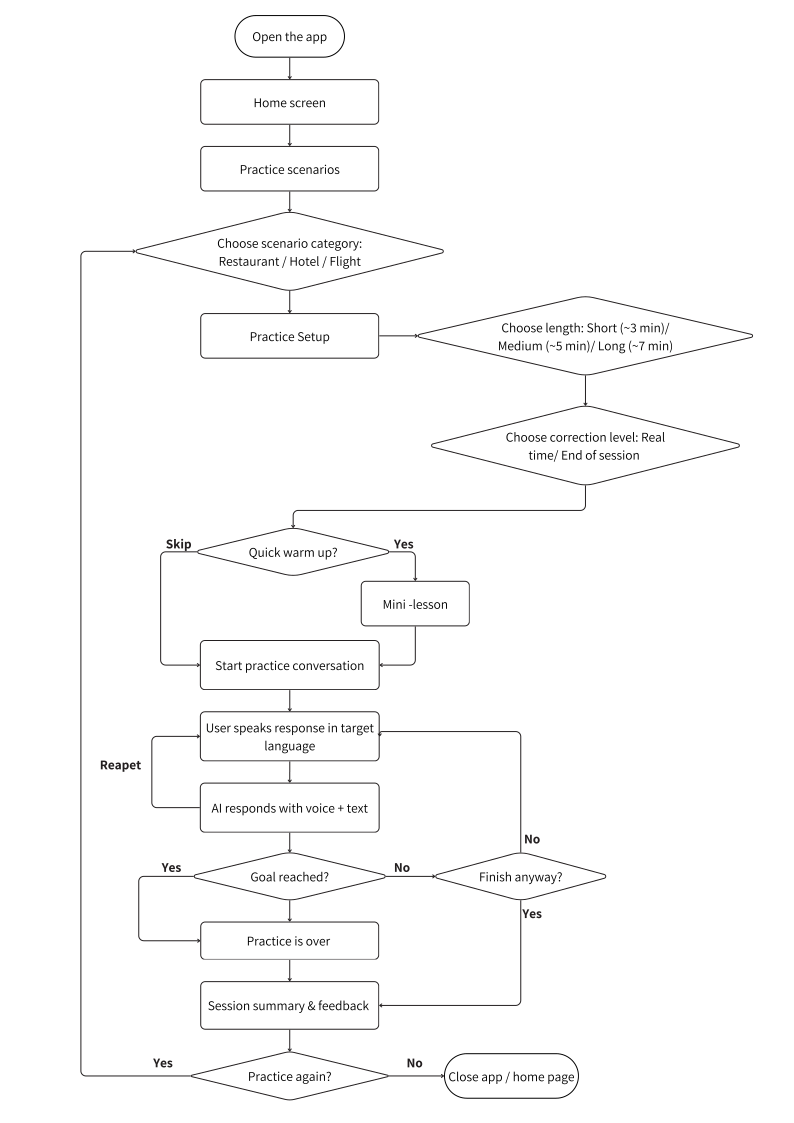
The user flow was designed to bridge the Theory-to-Practice gap by moving users quickly from setup to active speaking. I focused on a seamless transition that prioritizes user control and immediate engagement.
Personalized Entry: Users select scenarios that match their immediate travel needs.
Customizable Safety Nets: To address speaking anxiety, I included options to choose session length and "Correction Level"- allowing users to decide if they want real-time feedback or a continuous flow.
The Learning Loop: A "Quick Warm-up" mini-lesson is optional, providing a gentle ramp-up for those feeling unprepared.
Success-Oriented Outcome: The flow ends with a session summary and constructive feedback, shifting the focus from "perfection" to functional communication.
🖼️
Wireframes
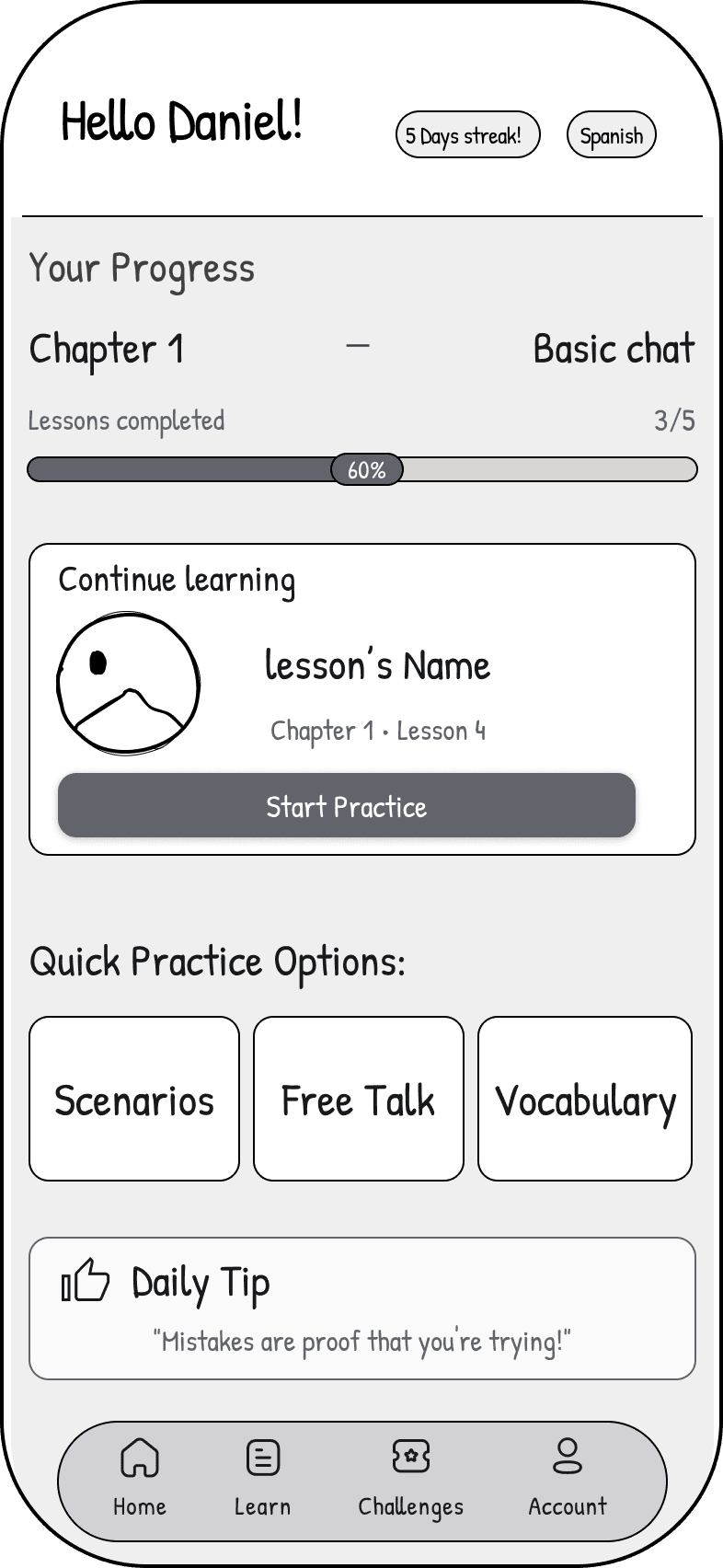
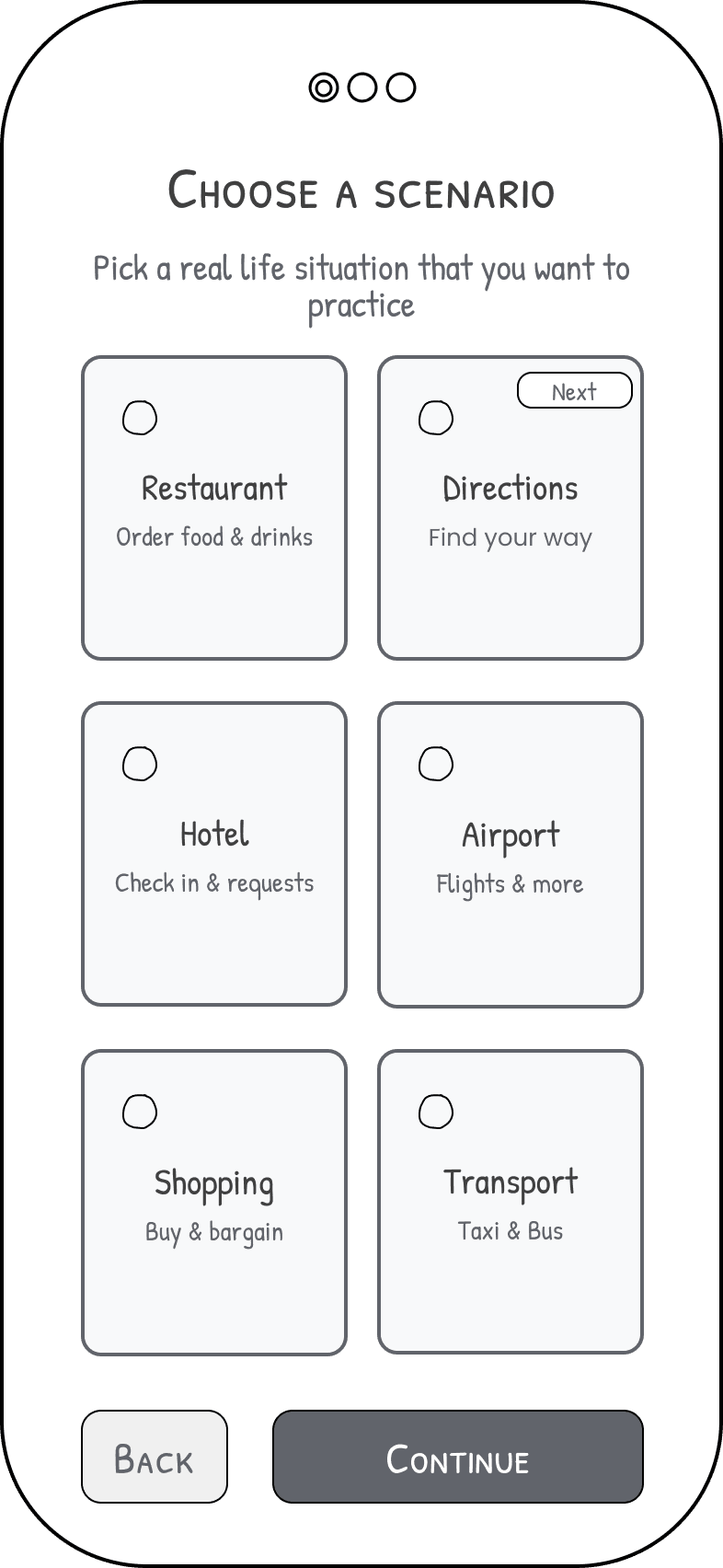
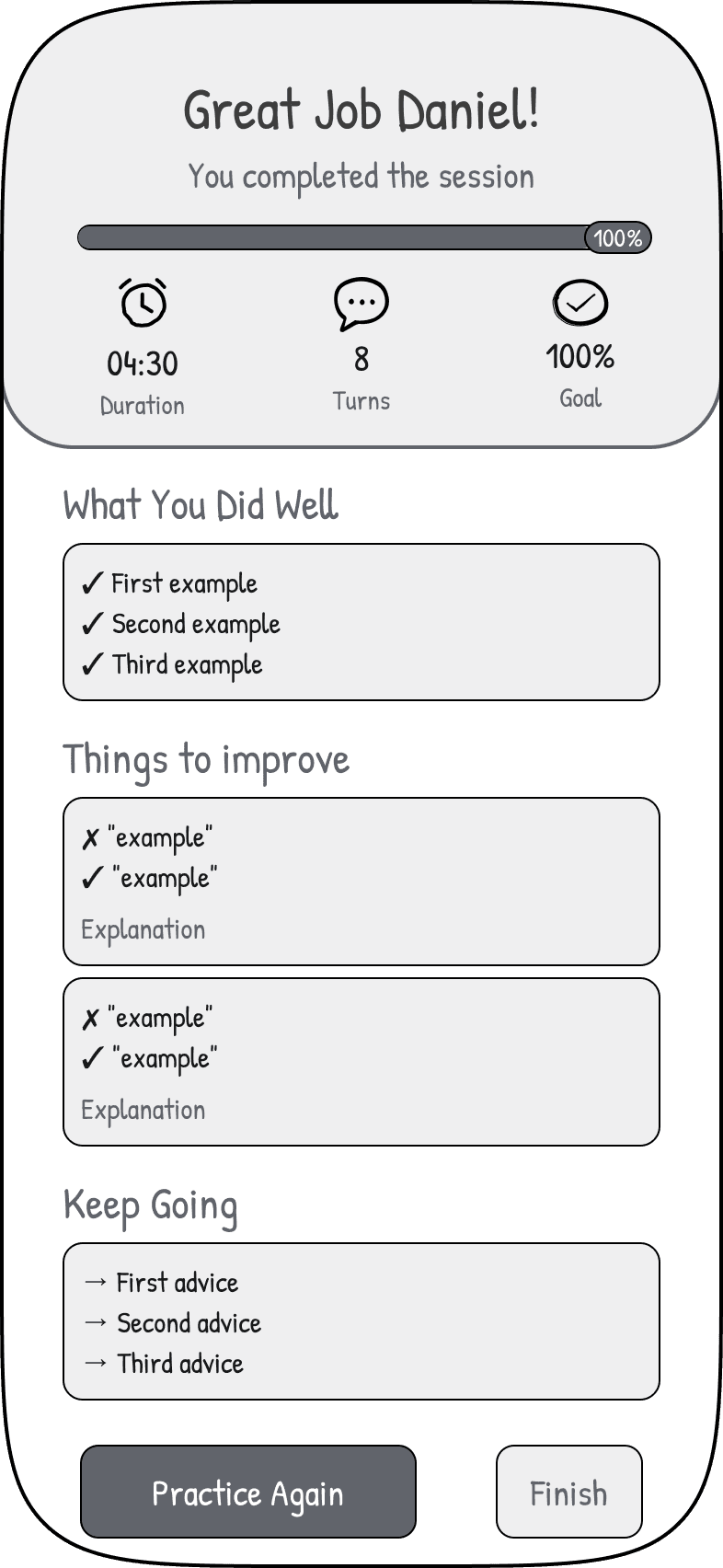
Next, I created wireframes to translate research into structure: straightforward paths, clean hierarchy, and screens that support speaking practice without distractions.
🎨
Final design
Home Screen
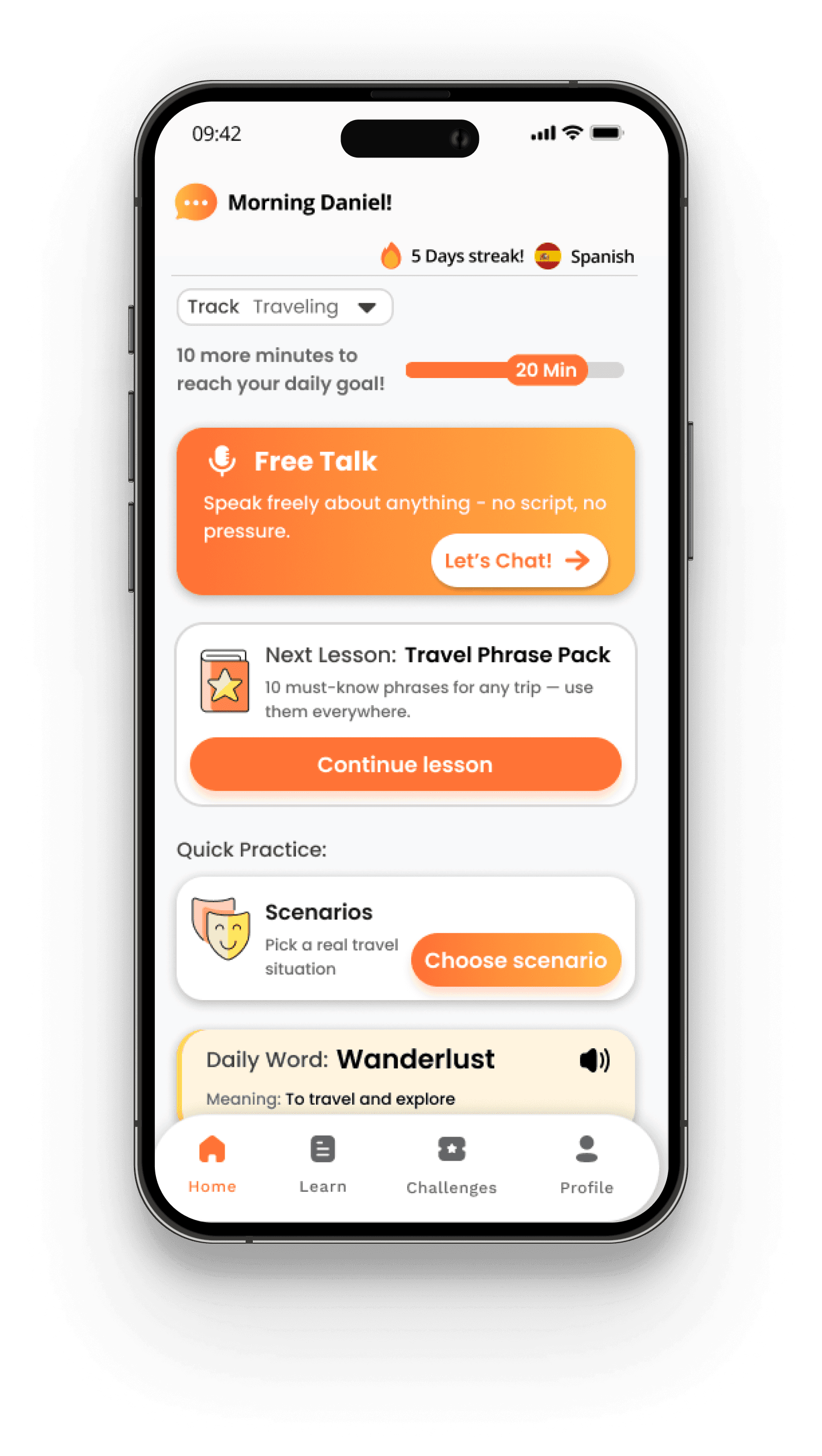
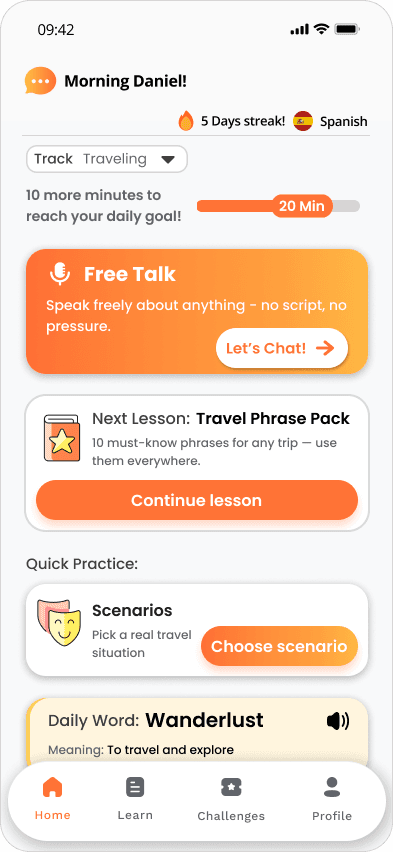
The Home screen designed to the preferences Yuval selected and presents practice options that are relevant to his goal of speaking Spanish confidently while traveling.
I designed Free Talk (no script) as the primary action to directly support the app’s core goal - learning through real conversation. It’s framed as a safe, low pressure entry point for speaking practice.
Next Lesson is a learning feature provides a structured learning path through vocabulary and expressions, allowing users to progress even when they’re not able to practice speaking.
Quick Scenario Entry is designed as a guided, speaking-first practice option, offering real-life prompts for focused, goal-driven practice while allowing natural responses.
This design placing speaking at the center of the experience. It offers an accessible middle ground through a combination of spontaneous conversation, guided speaking scenarios, and structured vocabulary learning - allowing users to build confidence, practice safely, and progress consistently without the cost or pressure of traditional tutoring.
Scenario Practice
I designed the scenario practice experience to directly tackle the core challenge identified in my research: bridging the gap between learning vocabulary and actually speaking with confidence in real-world situations.
The flow prioritizes user control and psychological safety:
Scenario Selection - I created six relatable real-life situations that users are most likely to encounter, providing practical, immediately applicable practice.
Personalized Setup - I gave users full control over practice length and correction level, responding to the insight that AI needs to feel supportive and patient, and that feedback timing is crucial for maintaining conversation flow.
Optional Warm-up - I added a preview of key phrases before the conversation starts, addressing the research finding that 49% of learners panic when speaking without preparation.
Session Summary Screen:
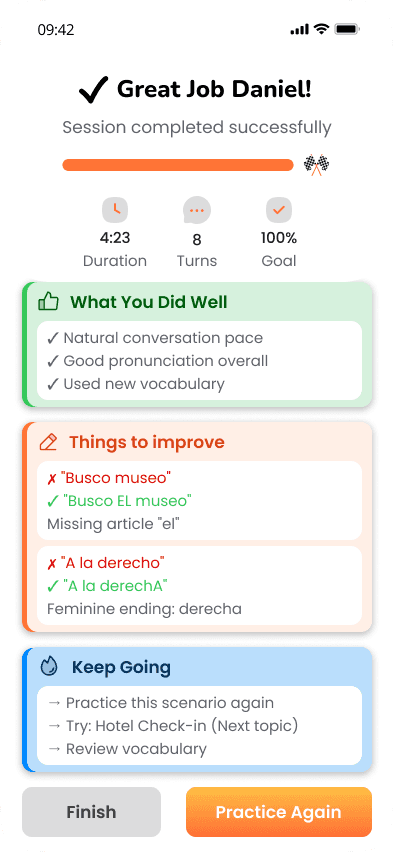
I designed the session summary With the goal of turning feedback from a source of anxiety into a positive moment of improvement. Instead of technical corrections, it offers a balanced, encouraging approach that builds confidence.
The summary begins with personalized praise and progress metrics, followed by strengths, gentle corrections with explanations, and clear next steps to keep users motivated.
This approach follows research advocating for empathetic, adaptive feedback that helps learners practice safely and build real speaking confidence over time.